UGBB - Blackborough End-type ware
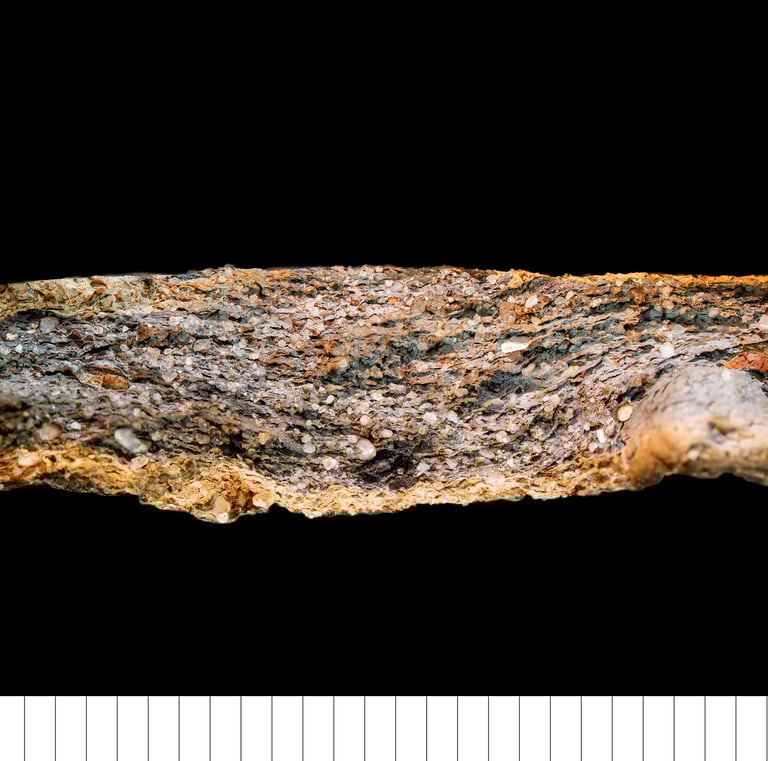
Common fine-medium sub-angular sand (clear, white), sparse burnt organics, rare very coarse angular flint and rare hard ferrous oxide/iron pan. Laminated appearance in section. Body sherds can appear similar to EMW, but true EMW tends to be better finished.
TS description (H. Page): Well sorted, very coarse and coarse rounded to sub-rounded few quartz and polycrystalline quartz, with few fine sand-sized rounded to subrounded quartz inclusions and microcrystalline quartz. Frequent very fine elongate biotite mica, rare, rounded chert inclusions, rare plagioclase and microcline feldspar, ferruginous opaque minerals and olivine and rock fragments of micaceous sandstone. Highly optically active, homogeneous, oxidised, yellow brown-red, non-calcareous matrix. Common discordant coarse dehydrated clay pellets with high optical density and sharp to merging edges, and large dark red-brown clay streaks. Oxidised external edges and less oxidised core. Frequent elongate macro- and mesochannels. Unlike the macroscopic fabric, there is no indication of burnt organic materials, or coarse flint used as tempering in thin-section.
Sample from Blackborough End, Middleton.
Copyright
This website, and the type series, was created by Dr Sue Anderson, Spoilheap Archaeology: www.spoilheap.co.uk
I am available for contract work on pottery from East Anglia and beyond. Email sue@spoilheap.co.uk
© 2024. All rights reserved.
To visit the type series at Suffolk County Council Archaeological Service, Bury St Edmunds, contact Faye Minter: Faye.Minter@suffolk.gov.uk
Tel: 01284 741 228 to make an appointment.